
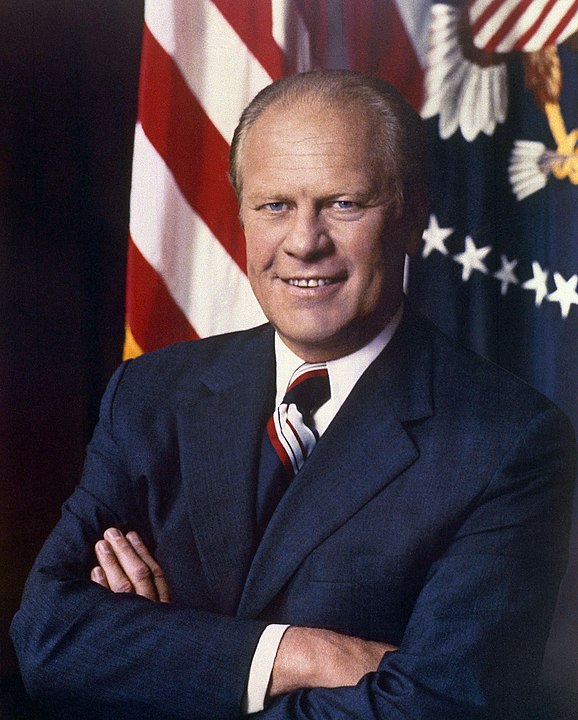
President Ford concedes the 1976 election to Jimmy Carter
Following the election, President Ford publicly conceded to Governor Jimmy Carter and acknowledged Carter as President-elect.
Gerald R. Ford (1913–2006) served as the 38th President of the United States from August 9, 1974, to January 20, 1977. A Republican and the only person to serve as both vice president and president without election to either office, he took office after Richard Nixon's resignation.
Ford assumed the presidency at the height of the Watergate crisis and sought to restore trust in government; his decision to grant Richard Nixon a full pardon was intended to move the nation forward but proved politically costly. He presided over the end stages of U.S. involvement in Vietnam, signed the Helsinki Accords to ease Cold War tensions, appointed John Paul Stevens to the Supreme Court, and is remembered for his plainspoken integrity and emphasis on national healing.
Historians credit Ford with stabilizing the executive branch after Watergate and making pragmatic decisions amid economic and international challenges, though some of those choices—most notably the Nixon pardon—remain controversial in assessments of his presidency.
Succeeded Richard Nixon following his resignation (Aug 9, 1974); Granted a full pardon to Richard Nixon (1974); Managed U.S. response to the Fall of Saigon and the Mayaguez incident (1975); Signed the Helsinki Accords to reduce Cold War tensions (1975); Appointed John Paul Stevens to the Supreme Court (1975); Signed the Education for All Handicapped Children Act (1975)
Key highlights and dated events associated with this presidency.
Showing 12 of 67 entries.
Following the election, President Ford publicly conceded to Governor Jimmy Carter and acknowledged Carter as President-elect.
The 1976 U.S. presidential election took place, and incumbent President Gerald R. Ford was defeated by Democrat Jimmy Carter.
Ford and Carter met for the third and final televised debate of the 1976 campaign, addressing economic and foreign-policy issues in the weeks before Election Day.
President Gerald Ford signed the Federal Land Policy and Management Act into law, establishing a framework for management and multiple use of public lands overseen by the Bureau of Land Management.
Ford signed RCRA, establishing federal authority and standards for the management, treatment, and disposal of solid and hazardous waste.
Ford signed the Copyright Act of 1976, the major overhaul of U.S. copyright law that updated protections for creative works and introduced new statutory rules.
Republican vice-presidential nominee Bob Dole, running mate of President Gerald Ford, debated Democratic nominee Walter Mondale in the only vice-presidential debate of the 1976 campaign.
Ford signed the Toxic Substances Control Act, giving the federal government authority to require testing, reporting, and regulation of chemical substances.
In the second televised debate with Jimmy Carter, President Ford asserted that 'there is no Soviet domination of Eastern Europe,' a remark widely criticized as inaccurate.
On September 23, 1976, President Gerald Ford and Democratic nominee Jimmy Carter met in the first of their presidential debates, during which Ford asserted, 'There is no Soviet domination of Eastern Europe,' a statement that drew immediate attention and criticism.
On August 21, 1976, U.S. and South Korean forces executed Operation Paul Bunyan—a heavily backed operation to cut down the poplar tree in the Joint Security Area—after the August 18 killings.
At the Republican National Convention in Kansas City, delegates nominated incumbent President Gerald R. Ford for reelection and selected Senator Bob Dole as his running mate, and Ford delivered his acceptance address.