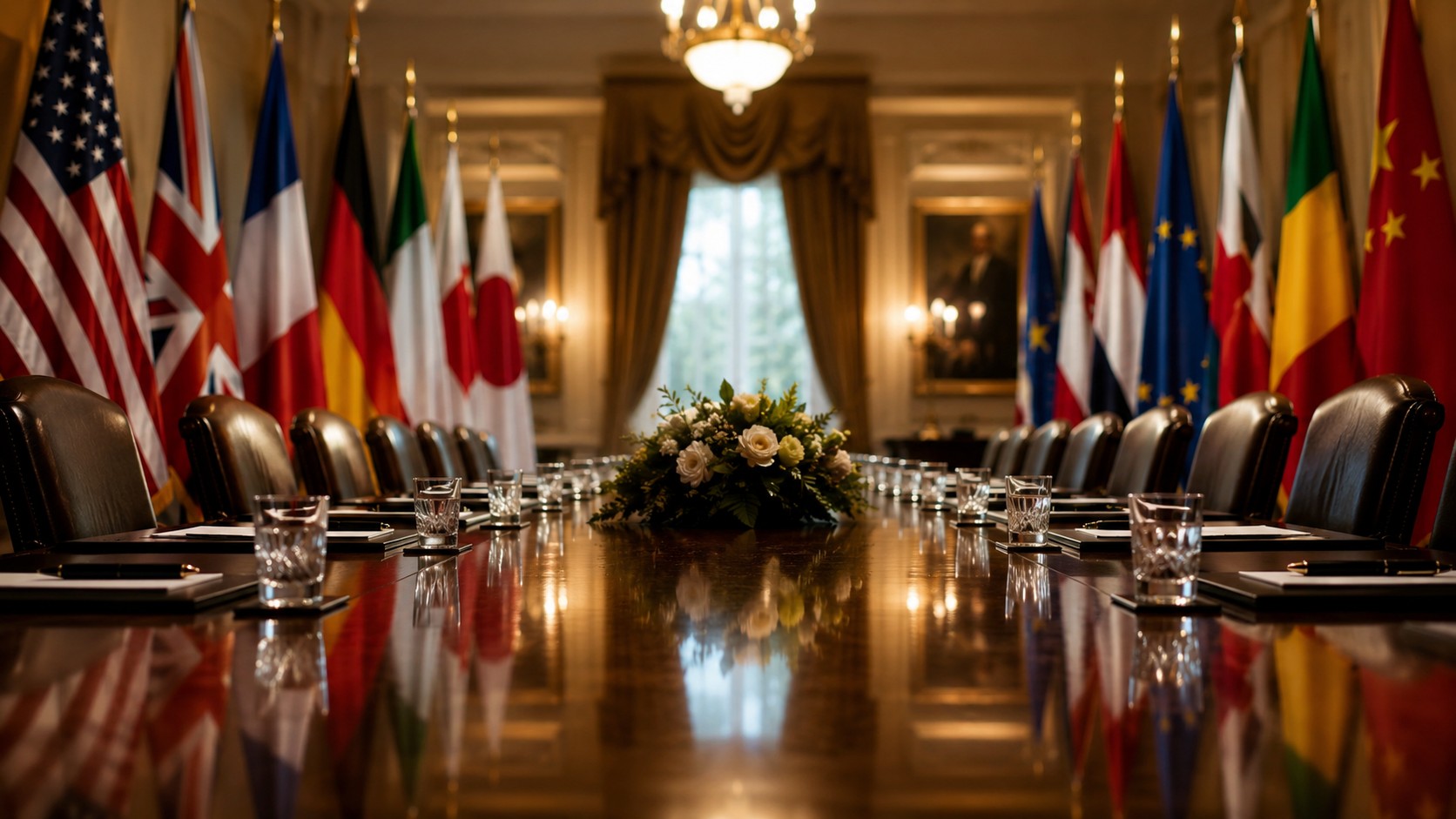
Trident Conference opens in Washington with Roosevelt and Churchill
President Franklin D. Roosevelt hosted British Prime Minister Winston Churchill in Washington as the Trident Conference formally opened to coordinate Allied strategy.
Franklin D. Roosevelt (1882–1945) was the 32nd President of the United States, serving from March 4, 1933, to April 12, 1945. A Democrat, he led the nation through the Great Depression and most of World War II.
Roosevelt reshaped the federal government's role in the economy through the New Deal, creating programs and institutions such as Social Security, the FDIC, and large-scale public works to relieve unemployment and stabilize finance.
He also guided the United States through World War II, overseeing mobilization, Lend-Lease, and Allied cooperation; his four-term presidency expanded the scope and influence of the executive branch and left a lasting global and domestic legacy, though some initiatives, like the 1937 court-packing plan, provoked controversy.
Implemented New Deal reforms including the Social Security Act; Stabilized banking and created the FDIC and SEC; Established large public works programs (WPA, CCC, TVA); Backed Lend-Lease and led U.S. mobilization in World War II; Elected to four terms, reshaping presidential precedent; Proposed 1937 Supreme Court reorganization (court-packing)
Key highlights and dated events associated with this presidency.
Showing 12 of 415 entries.
President Franklin D. Roosevelt hosted British Prime Minister Winston Churchill in Washington as the Trident Conference formally opened to coordinate Allied strategy.
Jewish fighters in the Warsaw Ghetto launched an armed revolt against German forces attempting to liquidate the ghetto and deport its remaining inhabitants to extermination camps.
U.S. Army Air Forces fighters, acting on decrypted Japanese communications, intercepted and shot down the plane carrying Admiral Isoroku Yamamoto over Bougainville, killing him.
German authorities announced the discovery of mass graves of Polish officers in the Katyn Forest and publicly attributed the killings to the Soviet NKVD.
On February 14, 1943 Axis forces attacked Allied positions at Kasserine Pass in Tunisia, initiating a multi-day engagement that produced severe losses and disorganized withdrawals by inexperienced U.S. forces.
On February 9, 1943, the Guadalcanal Campaign concluded as Japanese forces completed their evacuation and Allied commanders declared the island secure.
The German 6th Army under General Friedrich Paulus formally surrendered to Soviet forces, ending the Battle of Stalingrad.
At the conclusion of the Casablanca Conference, Roosevelt and Churchill agreed to prioritize operations in the Mediterranean and authorized planning for the Allied invasion of Sicily (Operation Husky).
At the close of the Casablanca Conference, Roosevelt and Churchill issued a declaration demanding the unconditional surrender of Germany, Italy, and Japan.
British Eighth Army forces seized Tripoli, the capital of Libya, driving Axis forces out of the country.
President Franklin D. Roosevelt and Prime Minister Winston Churchill convened the Casablanca Conference in French Morocco to coordinate Allied strategy for 1943.
President Franklin D. Roosevelt delivered his annual message to Congress outlining wartime priorities and postwar objectives, stressing unity and continued mobilization.