Hungarian uprising against Soviet rule begins in Budapest
On October 23, 1956, mass demonstrations in Budapest against Hungary’s Soviet-backed government escalated into a nationwide uprising.
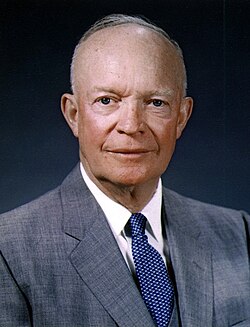
Dwight D. Eisenhower (1890-1969) was a five-star general in World War II and served as the 34th President of the United States from 1953-1961. A Republican, he presided over postwar prosperity, built the Interstate Highway System, and shaped early Cold War policy.
Eisenhower's presidency stabilized the United States during a period of economic growth and Cold War tension. He prioritized infrastructure and scientific investment, signing the Federal-Aid Highway Act and creating NASA while pursuing containment and cautious diplomacy.
He advanced civil rights enforcement in limited but consequential ways—sending federal troops to enforce desegregation at Little Rock and signing the Civil Rights Act of 1957—and appointed Chief Justice Earl Warren, influencing landmark Supreme Court rulings. His farewell warning about the "military-industrial complex" and the use of covert actions during the Cold War have left a complex and lasting legacy.
Supreme Allied Commander in World War II; Negotiated a Korean War armistice, ending large-scale combat; Created the Interstate Highway System (Federal-Aid Highway Act of 1956); Established NASA (1958) and strengthened the U.S. space program; Enforced school desegregation at Little Rock and signed the Civil Rights Act of 1957; Warned of the "military-industrial complex" in his 1961 farewell address
Key highlights and dated events associated with this presidency.
Showing 12 of 271 entries.
On October 23, 1956, mass demonstrations in Budapest against Hungary’s Soviet-backed government escalated into a nationwide uprising.
One day after his nomination by President Eisenhower, the U.S. Senate confirmed William J. Brennan Jr. to the Supreme Court.
Eisenhower nominated New Jersey Supreme Court Justice William J. Brennan Jr. to fill a vacancy on the U.S. Supreme Court.
The convention concluded by officially reaffirming Dwight D. Eisenhower as the Republican presidential nominee and Richard Nixon as the vice-presidential nominee for 1956.
The Republican National Convention convened in San Francisco to consider the renomination of President Dwight D. Eisenhower and Vice President Richard Nixon for the 1956 election.
President Eisenhower publicly called for the United Nations to mediate the dispute over the Suez Canal following Egypt’s nationalization announcement.
On July 27, 1956 President Eisenhower called for the United Nations to take up Egypt's nationalization of the Suez Canal and pressed for a peaceful, multilateral resolution.
Egyptian President Gamal Abdel Nasser declared the nationalization of the Suez Canal Company to finance the Aswan Dam after Western funding was withheld.
The Eisenhower administration announced it would not provide the requested U.S. financing for the Aswan High Dam project in Egypt.
The United States announced it would not provide the expected financing for Egypt’s Aswan High Dam project, withdrawing support amid concerns about Nasser’s foreign alignments.
The Eisenhower administration announced it would not provide the expected U.S. financing for Egypt’s Aswan High Dam project.
President Eisenhower signed the Federal-Aid Highway Act of 1956, authorizing the construction of the National Interstate and Defense Highways and creating the Highway Trust Fund to finance it.