Bombing destroys U.S. Embassy in Beirut
A suicide car bombing destroyed the United States Embassy compound in Beirut, Lebanon, killing 63 people, including 17 Americans.
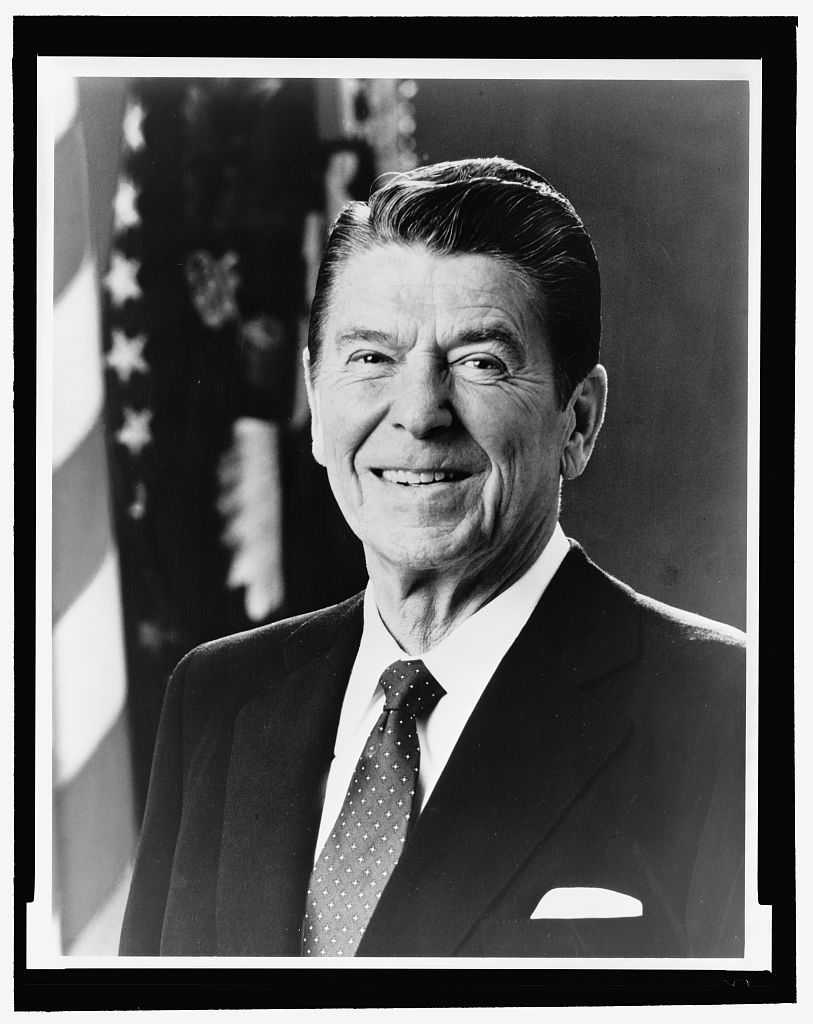
Ronald Reagan was the 40th president of the United States, serving two terms from January 1981 to January 1989. A former actor and governor of California, he promoted conservative economic policies and a firm stance against the Soviet Union.
Reagan pursued supply-side economic policies—large tax cuts, deregulation, and shifts in spending—that helped lower inflation and stimulate growth but also coincided with rising federal deficits and greater income inequality.
On foreign policy he combined a military buildup and tough rhetoric toward the USSR with later diplomacy with Mikhail Gorbachev that advanced arms-control agreements; his presidency was also marred by the Iran–Contra affair.
Enacted major tax cuts with the Economic Recovery Tax Act of 1981; Pursued deregulation and conservative judicial appointments; Increased defense spending and advanced the Strategic Defense Initiative; Negotiated with Mikhail Gorbachev, contributing to U.S.–Soviet arms reductions; Re-elected in a 1984 landslide victory; Administration tarnished by the Iran–Contra affair
Key highlights and dated events associated with this presidency.
Showing 12 of 189 entries.
A suicide car bombing destroyed the United States Embassy compound in Beirut, Lebanon, killing 63 people, including 17 Americans.

In a nationally televised speech, Reagan proposed the Strategic Defense Initiative, a major research effort to develop space- and ground-based systems to protect the United States from strategic ballistic nuclear missiles.
Speaking to the National Association of Evangelicals in Orlando, Reagan denounced the Soviet Union as an "evil empire," sharply criticizing its ideology and global behavior.
President Ronald Reagan delivered the State of the Union to a joint session of Congress, outlining his economic priorities, advocating continued defense buildup, and calling for cuts in domestic spending.
President Reagan transmitted his FY1984 budget to Congress, outlining higher defense spending alongside proposed reductions in many domestic discretionary programs.
President Ronald Reagan delivered the 1983 State of the Union Address, outlining his administration's priorities on national defense, economic policy, and government reform.
On December 21, 1982, Congress approved the first Boland Amendment, a legislative restriction prohibiting U.S. assistance to private groups engaged in military or paramilitary operations aimed at overthrowing the Nicaraguan government.
In the November 2, 1982 midterm elections, the Democratic Party made substantial gains in the U.S. House of Representatives and improved its position in state and local contests, while Republicans lost ground amid a deep recession.
President Reagan signed the Garn–St. Germain Depository Institutions Act (Public Law 97-320), which relaxed federal regulations on savings and loan associations and expanded the use of adjustable-rate and balloon mortgages.
President Reagan delivered a major address to the UN General Assembly in New York, outlining U.S. positions on disarmament, the Lebanon crisis, and broader Cold War concerns.
Over September 16–18, Phalangist militia forces killed large numbers of Palestinian and Lebanese civilians in the Sabra and Shatila refugee camps while Israeli forces controlled the surrounding area.
Bashir Gemayel, leader of the Lebanese Forces and newly elected president of Lebanon, was killed by a bomb in Beirut.