The POTUS Timeline
President #34

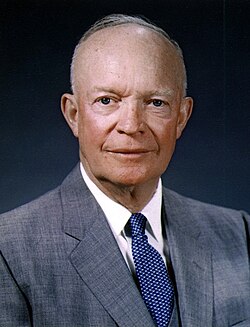
Dwight D. Eisenhower

Dwight D. Eisenhower (1890-1969) was a five-star general in World War II and served as the 34th President of the United States from 1953-1961. A Republican, he presided over postwar prosperity, built the Interstate Highway System, and shaped early Cold War policy.

Legacy Summary

Eisenhower's presidency stabilized the United States during a period of economic growth and Cold War tension. He prioritized infrastructure and scientific investment, signing the Federal-Aid Highway Act and creating NASA while pursuing containment and cautious diplomacy.

He advanced civil rights enforcement in limited but consequential ways—sending federal troops to enforce desegregation at Little Rock and signing the Civil Rights Act of 1957—and appointed Chief Justice Earl Warren, influencing landmark Supreme Court rulings. His farewell warning about the "military-industrial complex" and the use of covert actions during the Cold War have left a complex and lasting legacy.

Notable Actions

Supreme Allied Commander in World War II; Negotiated a Korean War armistice, ending large-scale combat; Created the Interstate Highway System (Federal-Aid Highway Act of 1956); Established NASA (1958) and strengthened the U.S. space program; Enforced school desegregation at Little Rock and signed the Civil Rights Act of 1957; Warned of the "military-industrial complex" in his 1961 farewell address

Timeline Entries

Key highlights and dated events associated with this presidency.

Showing 12 of 271 entries.

Browse full timeline
West Germany formally joins NATO
May 9, 1955 Dwight D. Eisenhower
Foreign Policy

West Germany formally joins NATO

On May 9, 1955 the Federal Republic of Germany became a full member of the North Atlantic Treaty Organization, completing its integration into Western defense arrangements after the Paris Agreements.

Senate formally censures Senator Joseph McCarthy
December 2, 1954 Dwight D. Eisenhower
Scandal

Senate formally censures Senator Joseph McCarthy

The U.S. Senate voted 67–22 on a resolution of censure, formally condemning Senator Joseph R. McCarthy for conduct unbecoming a senator after the Army–McCarthy hearings and related investigations.