Congress passes the Gulf of Tonkin Resolution
On August 7 Congress overwhelmingly approved the Gulf of Tonkin Resolution, giving the president broad authority to assist any Southeast Asian country and take measures to repel attacks.
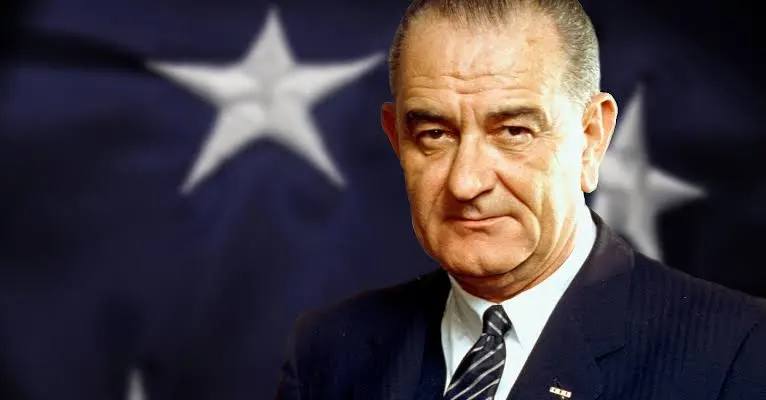
Lyndon B. Johnson, a Democrat from Texas, became president after John F. Kennedy's assassination in 1963 and served until 1969. He pursued an ambitious domestic agenda while presiding over a major escalation of the Vietnam War.
Johnson’s domestic agenda, known as the Great Society, expanded civil rights, health care, education, and anti-poverty programs, producing landmark laws such as the Civil Rights Act, the Voting Rights Act, Medicare, and Medicaid.
His decision to escalate U.S. military involvement in Vietnam eroded public support and overshadowed many of his achievements, leaving a complex legacy that reshaped civil rights, social policy, and debates over U.S. foreign intervention.
Signed the Civil Rights Act (1964) and Voting Rights Act (1965); Created Medicare and Medicaid (1965); Launched the Great Society and War on Poverty initiatives; Escalated U.S. military involvement in the Vietnam War; Enacted the Immigration and Nationality Act (1965)
Key highlights and dated events associated with this presidency.
Showing 12 of 216 entries.
On August 7 Congress overwhelmingly approved the Gulf of Tonkin Resolution, giving the president broad authority to assist any Southeast Asian country and take measures to repel attacks.

On August 5 President Johnson authorized carrier-based and Navy/air strikes against North Vietnamese patrol boats and facilities in a retaliatory operation known as Operation Pierce Arrow.
On August 4, 1964 President Lyndon B. Johnson delivered a televised/radio statement and sent a message to Congress requesting authority to take all necessary measures to repel armed attacks and prevent further aggression in Southeast Asia following reported incidents in the Gulf of Tonkin.
On August 4 the Johnson administration reported a second torpedo-boat attack against U.S. destroyers in the Gulf of Tonkin, an incident later subject to controversy and debate.
On August 2, North Vietnamese torpedo boats engaged the U.S. destroyer USS Maddox in the Gulf of Tonkin, damaging the vessel and prompting U.S. reporting of the incident.
Ranger 7 impacted the Moon after transmitting high-resolution photographs of the lunar surface back to Earth, the first such detailed images returned by a U.S. spacecraft.
NASA launched the Ranger 7 spacecraft from Cape Kennedy on a mission to impact the Moon and return close-up images of the lunar surface.
On July 16, 1964, delegates at the Republican National Convention in San Francisco formally nominated Senator Barry Goldwater as the Republican nominee for president.
Johnson signed landmark civil rights legislation outlawing discrimination in public life.
Federal Bureau of Investigation personnel were sent to Mississippi to assist local authorities in locating James Chaney, Andrew Goodman, and Michael Schwerner after their disappearance on June 21, 1964.
Volunteers Andrew Goodman, James Chaney, and Michael Schwerner went missing after investigating church burnings in Neshoba County during Freedom Summer, prompting a major search and federal inquiry.
The Senate approved the Civil Rights Act by a 73–27 vote, completing the Senate’s consideration of the bill and sending it back to the House for final reconciliation and approval.