NASA launches Ranger 6 lunar probe; onboard TV cameras fail
On Jan 30, 1964 NASA launched Ranger 6 to impact the Moon and transmit close-up television images, but the spacecraft's TV cameras failed and no images were returned.
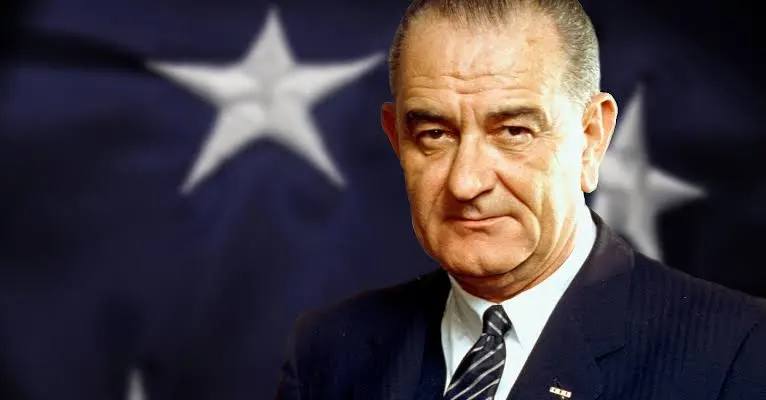
Lyndon B. Johnson, a Democrat from Texas, became president after John F. Kennedy's assassination in 1963 and served until 1969. He pursued an ambitious domestic agenda while presiding over a major escalation of the Vietnam War.
Johnson’s domestic agenda, known as the Great Society, expanded civil rights, health care, education, and anti-poverty programs, producing landmark laws such as the Civil Rights Act, the Voting Rights Act, Medicare, and Medicaid.
His decision to escalate U.S. military involvement in Vietnam eroded public support and overshadowed many of his achievements, leaving a complex legacy that reshaped civil rights, social policy, and debates over U.S. foreign intervention.
Signed the Civil Rights Act (1964) and Voting Rights Act (1965); Created Medicare and Medicaid (1965); Launched the Great Society and War on Poverty initiatives; Escalated U.S. military involvement in the Vietnam War; Enacted the Immigration and Nationality Act (1965)
Key highlights and dated events associated with this presidency.
Showing 12 of 216 entries.
On Jan 30, 1964 NASA launched Ranger 6 to impact the Moon and transmit close-up television images, but the spacecraft's TV cameras failed and no images were returned.

The 24th Amendment to the U.S. Constitution, prohibiting the use of poll taxes in federal elections, was certified as fully ratified on January 23, 1964.
Surgeon General Luther Terry released the landmark report 'Smoking and Health' concluding that cigarette smoking is causally related to lung cancer and other diseases.
Beginning Jan 9, 1964, protests over the raising of the Panamanian flag in the Panama Canal Zone escalated into violent confrontations between Panamanian civilians and Canal Zone authorities, producing significant casualties and unrest.
President Lyndon B. Johnson delivered his 1964 State of the Union to Congress, laying out a broad domestic program that emphasized a major tax reduction, measures to combat poverty, and support for civil‑rights legislation.
President Lyndon B. Johnson swore in the members of the President's Commission on the Assassination of President Kennedy (the Warren Commission) at the start of the panel's formal work.
Johnson signed the executive order creating the President's Commission on the Assassination of President Kennedy, commonly known as the Warren Commission, to investigate the assassination.
On November 27, 1963, President Lyndon B. Johnson addressed a joint session of Congress, urging rapid passage of President Kennedy's proposals, including a major tax cut and civil rights legislation, and calling for national unity.
President Johnson participated in the state funeral services for John F. Kennedy at the U.S. Capitol and Arlington National Cemetery.
On November 24, 1963, Jack Ruby fatally shot Lee Harvey Oswald, the accused assassin of President John F. Kennedy, in the basement of the Dallas Police Headquarters while Oswald was being transferred to county jail.
President Johnson issued a proclamation declaring a period of national mourning and directed U.S. government flags to be flown at half-staff following President Kennedy’s assassination.
Following President John F. Kennedy's assassination, Lyndon B. Johnson took the presidential oath aboard Air Force One at Dallas Love Field, administered by U.S. District Judge Sarah T. Hughes.