Panmunjom axe murders in the Korean Demilitarized Zone
On August 18, 1976, two U.S. Army officers were killed by North Korean soldiers in the Joint Security Area at Panmunjom during a confrontation while pruning a tree.
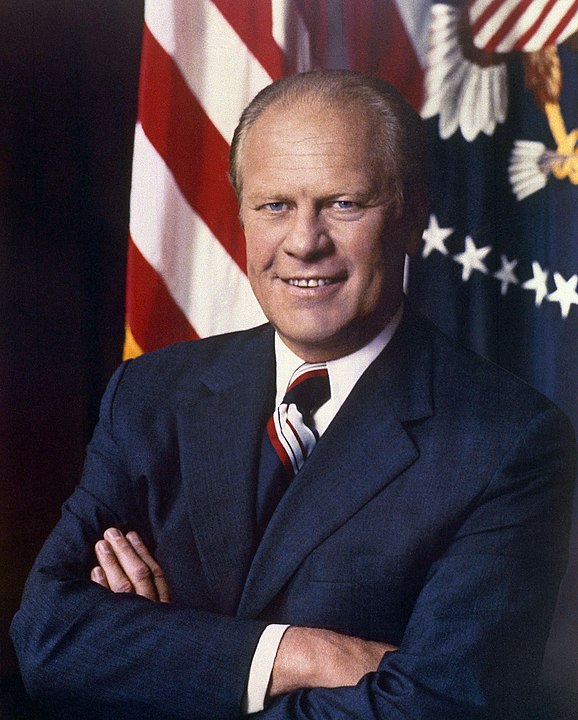
Gerald R. Ford (1913–2006) served as the 38th President of the United States from August 9, 1974, to January 20, 1977. A Republican and the only person to serve as both vice president and president without election to either office, he took office after Richard Nixon's resignation.
Ford assumed the presidency at the height of the Watergate crisis and sought to restore trust in government; his decision to grant Richard Nixon a full pardon was intended to move the nation forward but proved politically costly. He presided over the end stages of U.S. involvement in Vietnam, signed the Helsinki Accords to ease Cold War tensions, appointed John Paul Stevens to the Supreme Court, and is remembered for his plainspoken integrity and emphasis on national healing.
Historians credit Ford with stabilizing the executive branch after Watergate and making pragmatic decisions amid economic and international challenges, though some of those choices—most notably the Nixon pardon—remain controversial in assessments of his presidency.
Succeeded Richard Nixon following his resignation (Aug 9, 1974); Granted a full pardon to Richard Nixon (1974); Managed U.S. response to the Fall of Saigon and the Mayaguez incident (1975); Signed the Helsinki Accords to reduce Cold War tensions (1975); Appointed John Paul Stevens to the Supreme Court (1975); Signed the Education for All Handicapped Children Act (1975)
Key highlights and dated events associated with this presidency.
Showing 12 of 67 entries.
On August 18, 1976, two U.S. Army officers were killed by North Korean soldiers in the Joint Security Area at Panmunjom during a confrontation while pruning a tree.
Delegates at the Kansas City Republican National Convention formally adopted the 1976 Republican Party platform, setting the party's policy positions for the general election.
The Republican National Convention convened in Kansas City, Missouri, beginning a four-day gathering of delegates that would culminate in Gerald R. Ford's formal nomination.
President Gerald R. Ford delivered a nationally broadcast Bicentennial address marking the 200th anniversary of the Declaration of Independence.
Ronald Reagan won the California Republican primary on June 8, 1976, defeating incumbent President Gerald Ford in one of the nation's largest delegate states.
On June 8, 1976, the U.S. Supreme Court ruled in Buckley v. Valeo, upholding limits on campaign contributions but striking down limits on independent campaign expenditures and candidates' personal spending.
The Teton Dam in eastern Idaho catastrophically failed on June 5, 1976, releasing massive flooding that destroyed homes, infrastructure, and farmland.
President Gerald Ford won the New Hampshire Republican presidential primary by a slim margin over Ronald Reagan, securing a key early primary victory.
Gerald Ford narrowly defeated Ronald Reagan in the New Hampshire Republican primary on Feb. 24, 1976, winning by a small margin.
President Gerald Ford narrowly defeated Ronald Reagan in the New Hampshire Republican presidential primary held on February 24, 1976.
Gerald Ford narrowly defeated Ronald Reagan in the New Hampshire Republican presidential primary, prevailing by a slim margin in a closely watched early contest.
On February 24, 1976, President Gerald R. Ford narrowly defeated Ronald Reagan in the New Hampshire Republican primary.