U.S.-British Destroyers-for-Bases Agreement Announced
Roosevelt announced an agreement to transfer 50 U.S. Navy destroyers to Britain in exchange for 99‑year leases on British bases in the Atlantic and Caribbean.

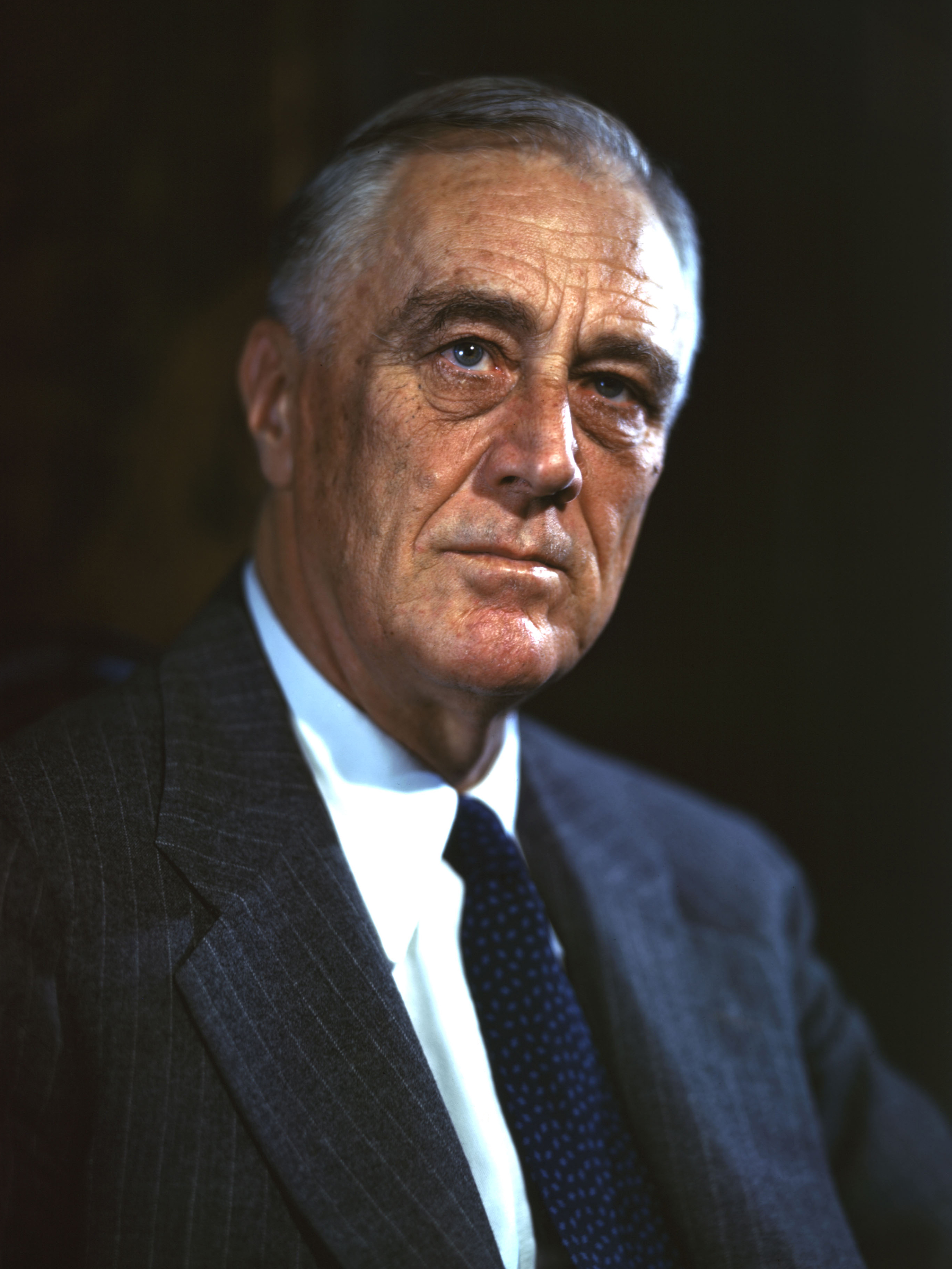
Franklin D. Roosevelt (1882–1945) was the 32nd President of the United States, serving from March 4, 1933, to April 12, 1945. A Democrat, he led the nation through the Great Depression and most of World War II.
Roosevelt reshaped the federal government's role in the economy through the New Deal, creating programs and institutions such as Social Security, the FDIC, and large-scale public works to relieve unemployment and stabilize finance.
He also guided the United States through World War II, overseeing mobilization, Lend-Lease, and Allied cooperation; his four-term presidency expanded the scope and influence of the executive branch and left a lasting global and domestic legacy, though some initiatives, like the 1937 court-packing plan, provoked controversy.
Implemented New Deal reforms including the Social Security Act; Stabilized banking and created the FDIC and SEC; Established large public works programs (WPA, CCC, TVA); Backed Lend-Lease and led U.S. mobilization in World War II; Elected to four terms, reshaping presidential precedent; Proposed 1937 Supreme Court reorganization (court-packing)
Key highlights and dated events associated with this presidency.
Showing 12 of 415 entries.
Roosevelt announced an agreement to transfer 50 U.S. Navy destroyers to Britain in exchange for 99‑year leases on British bases in the Atlantic and Caribbean.
Roosevelt announced an agreement to transfer 50 U.S. Navy destroyers to Great Britain in exchange for 99-year base leases on British possessions in the Western Hemisphere.
President Roosevelt signed the Two-Ocean Navy Act, authorizing a major expansion of the U.S. Navy to prepare for potential conflicts in both the Atlantic and Pacific.
President Roosevelt signed the Two‑Ocean Navy Act, authorizing a large naval expansion and substantial appropriations to strengthen the U.S. fleet.
At the Republican National Convention in Philadelphia, delegates nominated businessman Wendell L. Willkie as the GOP candidate to oppose Franklin D. Roosevelt in the 1940 presidential election.
After being renominated at the Chicago convention, Roosevelt delivered his acceptance address outlining his case for a third term and his national defense priorities.
At the Democratic National Convention in Chicago, delegates nominated Franklin D. Roosevelt for an unprecedented third presidential term and chose Henry A. Wallace as his running mate.
The Democratic National Convention in Chicago formally renominated Franklin D. Roosevelt for an unprecedented third term and selected Henry A. Wallace as the party's vice-presidential nominee.
The Democratic National Convention in Chicago formally renominated Franklin D. Roosevelt for an unprecedented third presidential term and selected Henry A. Wallace as the party's vice-presidential nominee.
The Roosevelt administration extended de facto diplomatic recognition to the new French government based in Vichy under Marshal Philippe Pétain.
On June 27, 1940, the Republican National Convention in Philadelphia nominated businessman Wendell L. Willkie as the party's presidential candidate to oppose Franklin D. Roosevelt in the November election.
On June 24, 1940, France and Italy signed a separate armistice following Italy’s entry into the war, formalizing terms between Rome and Vichy France.