
George M. Humphrey sworn in as Secretary of the Treasury
George M. Humphrey was sworn in as Secretary of the Treasury for President Eisenhower.
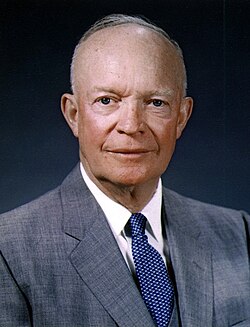
Dwight D. Eisenhower (1890-1969) was a five-star general in World War II and served as the 34th President of the United States from 1953-1961. A Republican, he presided over postwar prosperity, built the Interstate Highway System, and shaped early Cold War policy.
Eisenhower's presidency stabilized the United States during a period of economic growth and Cold War tension. He prioritized infrastructure and scientific investment, signing the Federal-Aid Highway Act and creating NASA while pursuing containment and cautious diplomacy.
He advanced civil rights enforcement in limited but consequential ways—sending federal troops to enforce desegregation at Little Rock and signing the Civil Rights Act of 1957—and appointed Chief Justice Earl Warren, influencing landmark Supreme Court rulings. His farewell warning about the "military-industrial complex" and the use of covert actions during the Cold War have left a complex and lasting legacy.
Supreme Allied Commander in World War II; Negotiated a Korean War armistice, ending large-scale combat; Created the Interstate Highway System (Federal-Aid Highway Act of 1956); Established NASA (1958) and strengthened the U.S. space program; Enforced school desegregation at Little Rock and signed the Civil Rights Act of 1957; Warned of the "military-industrial complex" in his 1961 farewell address
Key highlights and dated events associated with this presidency.
Showing 7 of 271 entries.
George M. Humphrey was sworn in as Secretary of the Treasury for President Eisenhower.

Herbert Brownell Jr. took the oath of office as U.S. Attorney General in the incoming Eisenhower administration.
Charles E. Wilson, former president of General Motors, was sworn in as Secretary of Defense under President Eisenhower.
John Foster Dulles was sworn in as Secretary of State in the new Eisenhower administration.
Richard M. Nixon took the oath of office as Vice President of the United States at the inauguration ceremonies on January 20, 1953.
Dwight D. Eisenhower was sworn in as the 34th President and delivered his first inaugural address on the steps of the Capitol.
A joint session of Congress formally counted the Electoral College ballots and certified Dwight D. Eisenhower as President-elect and Richard M. Nixon as Vice President-elect for the 1952 election.