
Adolf Hitler commits suicide in Berlin
On April 30, Adolf Hitler killed himself in his Berlin bunker as Soviet forces closed on the city, effectively ending Nazi leadership.
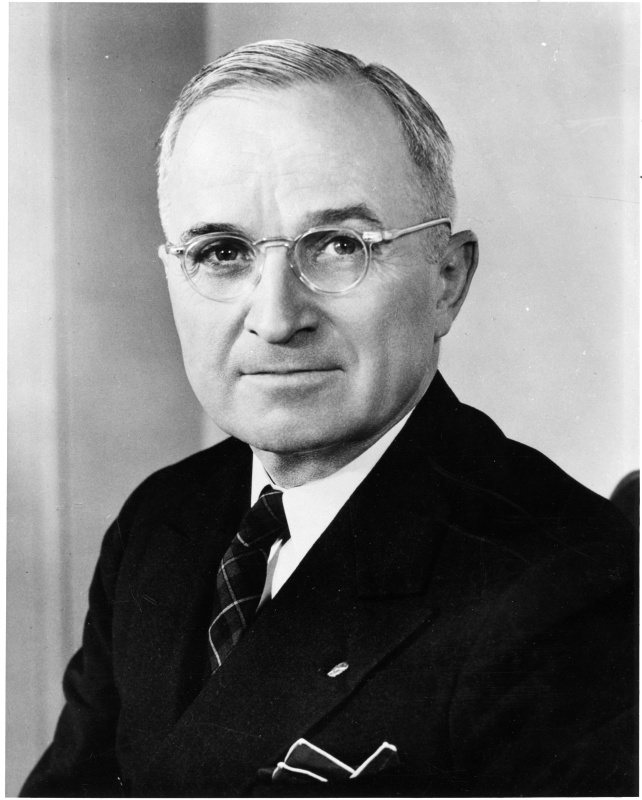
Harry S. Truman (1884–1972) was the 33rd President of the United States, serving from April 12, 1945 to January 20, 1953. A Democrat, he assumed the presidency after Franklin D. Roosevelt's death and guided the nation through the end of World War II and the early Cold War.
Truman reshaped America's postwar role, moving the nation from global war to Cold War leadership through the Marshall Plan, the Truman Doctrine, the Berlin Airlift, and the creation of NATO while confronting crises such as the Korean War.
On the domestic front he promoted the Fair Deal and took historic steps on civil rights, notably issuing Executive Order 9981 to desegregate the armed forces; his plainspoken leadership and decisive choices left a complex but enduring legacy that gained greater respect over time.
Assumed the presidency in 1945 and guided the transition from World War II to peacetime; Authorized use of atomic weapons against Japan (Hiroshima and Nagasaki); Articulated the Truman Doctrine and enacted the Marshall Plan to contain Soviet expansion; Supported the Berlin Airlift and helped establish NATO; Recognized the State of Israel in 1948; Issued Executive Order 9981 to desegregate the armed forces and led the U.S. during the Korean War (1950–1953)
Key highlights and dated events associated with this presidency.
Showing 12 of 276 entries.
On April 30, Adolf Hitler killed himself in his Berlin bunker as Soviet forces closed on the city, effectively ending Nazi leadership.
On April 28, Italian partisans captured and executed former fascist leader Benito Mussolini and his mistress near Lake Como; their bodies were subsequently displayed in Milan.
On April 25, 1945, American and Soviet forces linked up near Torgau on the Elbe River, establishing contact between the Western and Eastern fronts in Germany.
Delegates from 50 Allied nations convened in San Francisco on April 25 to begin drafting the United Nations Charter at the UN Conference on International Organization.
On April 16, 1945, Soviet forces under Marshal Zhukov and Konev commenced the final large-scale assault on Berlin, initiating the Battle of Berlin.
British troops liberated the Bergen‑Belsen concentration camp in Germany on April 15, finding thousands of unburied dead and tens of thousands of survivors in dire condition.
Following state funeral services in Washington, Franklin D. Roosevelt's body was transported to his family estate in Hyde Park, New York, where he was buried on April 15, 1945.
Funeral services and memorial events for Franklin D. Roosevelt were held on April 14, with newly sworn President Truman participating in national mourning and burial ceremonies at Hyde Park.
On April 12, 1945, soon after taking office, President Truman was briefed by Secretary of War Henry Stimson and leading scientists about the top-secret Manhattan Project and informed that the United States was close to producing an atomic weapon.
Truman took the presidential oath of office at the White House on April 12, 1945, formally beginning his administration.
After President Franklin D. Roosevelt died at Warm Springs, Georgia, Vice President Harry S. Truman succeeded to the presidency on April 12, 1945.
On April 1, U.S. forces launched amphibious assaults on Okinawa, initiating Operation Iceberg, one of the largest Pacific campaigns of World War II.