Crash of USAF C-5 During Operation Babylift
A U.S. Air Force C-5 transport carrying evacuees as part of Operation Babylift crashed shortly after takeoff from Tan Son Nhut airfield, resulting in heavy loss of life among passengers and crew.

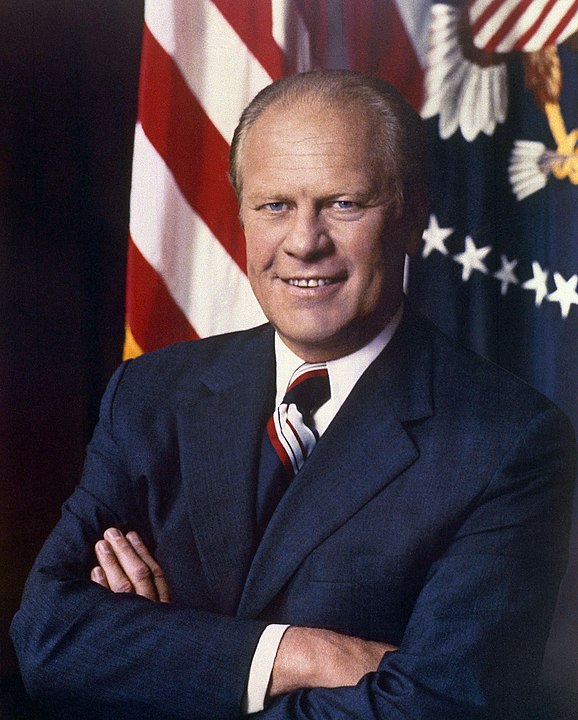
Gerald R. Ford (1913–2006) served as the 38th President of the United States from August 9, 1974, to January 20, 1977. A Republican and the only person to serve as both vice president and president without election to either office, he took office after Richard Nixon's resignation.
Ford assumed the presidency at the height of the Watergate crisis and sought to restore trust in government; his decision to grant Richard Nixon a full pardon was intended to move the nation forward but proved politically costly. He presided over the end stages of U.S. involvement in Vietnam, signed the Helsinki Accords to ease Cold War tensions, appointed John Paul Stevens to the Supreme Court, and is remembered for his plainspoken integrity and emphasis on national healing.
Historians credit Ford with stabilizing the executive branch after Watergate and making pragmatic decisions amid economic and international challenges, though some of those choices—most notably the Nixon pardon—remain controversial in assessments of his presidency.
Succeeded Richard Nixon following his resignation (Aug 9, 1974); Granted a full pardon to Richard Nixon (1974); Managed U.S. response to the Fall of Saigon and the Mayaguez incident (1975); Signed the Helsinki Accords to reduce Cold War tensions (1975); Appointed John Paul Stevens to the Supreme Court (1975); Signed the Education for All Handicapped Children Act (1975)
Key highlights and dated events associated with this presidency.
Showing 12 of 67 entries.
A U.S. Air Force C-5 transport carrying evacuees as part of Operation Babylift crashed shortly after takeoff from Tan Son Nhut airfield, resulting in heavy loss of life among passengers and crew.
The Ford administration initiated Operation Babylift, a U.S.-led program to evacuate Vietnamese orphans and other children from South Vietnam to the United States and allied countries.
Following the loss of Ban Mê Thuột, South Vietnamese leaders ordered a withdrawal from the Central Highlands that resulted in a chaotic, disorderly retreat and heavy territorial losses.
North Vietnamese forces seized the city of Ban Mê Thuột in South Vietnam's Central Highlands, marking the opening of a large-scale 1975 offensive against the South Vietnamese government.
The Senate confirmed Edward H. Levi as U.S. Attorney General, and he was sworn into office to lead the Justice Department under President Gerald Ford.
President Ford delivered his 1975 State of the Union Address to a joint session of Congress, outlining priorities including combating inflation, energy policy, fiscal restraint, and national security.
On December 19, 1974 the House voted to confirm President Ford's nomination of Nelson A. Rockefeller to be Vice President under the 25th Amendment.
Nelson A. Rockefeller was officially sworn in as Vice President of the United States, completing Gerald Ford's nomination under the 25th Amendment.
The U.S. Senate voted to confirm Gerald R. Ford's nomination of Nelson A. Rockefeller to be Vice President under the 25th Amendment.
On November 23, 1974, President Gerald Ford and Soviet General Secretary Leonid Brezhnev concluded the Vladivostok talks, announcing accords that established numerical ceilings on U.S. and Soviet strategic offensive arms (ICBMs, SLBMs and heavy bombers).
President Gerald R. Ford formally nominated former New York governor Nelson A. Rockefeller to be Vice President under the 25th Amendment, subject to confirmation by Congress.
On November 5, 1974, midterm elections held in the wake of Watergate produced substantial Democratic gains in both the House and the Senate.