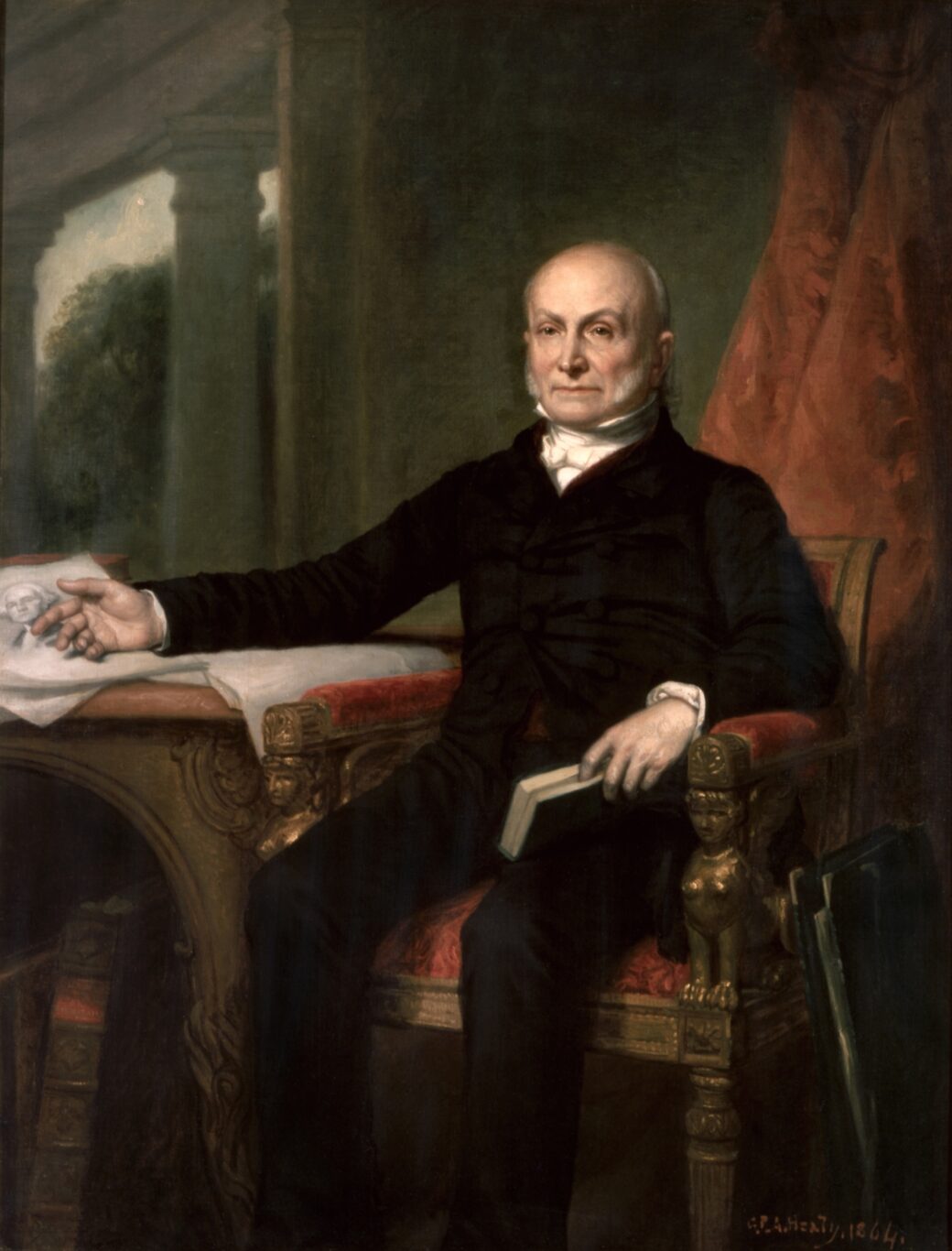
The POTUS Timeline
President #6

John Quincy Adams

John Quincy Adams (1767–1848) was the sixth President of the United States, serving from 1825 to 1829. A member of the Democratic-Republican Party and a seasoned diplomat, he later served nearly two decades in the House where he became a prominent opponent of slavery.

Legacy Summary

As president Adams promoted a national program of internal improvements, scientific advancement, and federal support for education, but his ambitious agenda faced strong political opposition. Elected by the House in 1824 amid charges of a “corrupt bargain,” he lacked a durable partisan base and lost reelection to Andrew Jackson.

After leaving the White House he served in the House of Representatives from 1829 until his death in 1848, earning distinction as a vigorous critic of slavery and as counsel for the Amistad captives. Historians regard him as an accomplished statesman whose principled public service and diplomatic record left a lasting, if complex, legacy.

Notable Actions

Sixth U.S. President (1825–1829), elected by the House amid the 1824 controversy;Served as Secretary of State (1817–1825) and helped shape the Monroe Doctrine;Advocated federal internal improvements, a national university, and scientific institutions;Signed the Tariff of 1828 during his administration;Defeated for reelection by Andrew Jackson in 1828;Long-serving U.S. Representative (1829–1848) and outspoken opponent of slavery, counsel in the Amistad case

Timeline Entries

Key highlights and dated events associated with this presidency.

Showing 12 of 15 entries.

Browse full timeline
Death of Thomas Jefferson
July 4, 1826 John Quincy Adams
Domestic Policy

Death of Thomas Jefferson

Thomas Jefferson, third U.S. president and principal author of the Declaration of Independence, died at Monticello on July 4, 1826.