Supreme Court rules in Texas v. Johnson that flag burning is protected speech
In a 5–4 decision the U.S. Supreme Court held that burning the American flag in protest is symbolic speech protected by the First Amendment.
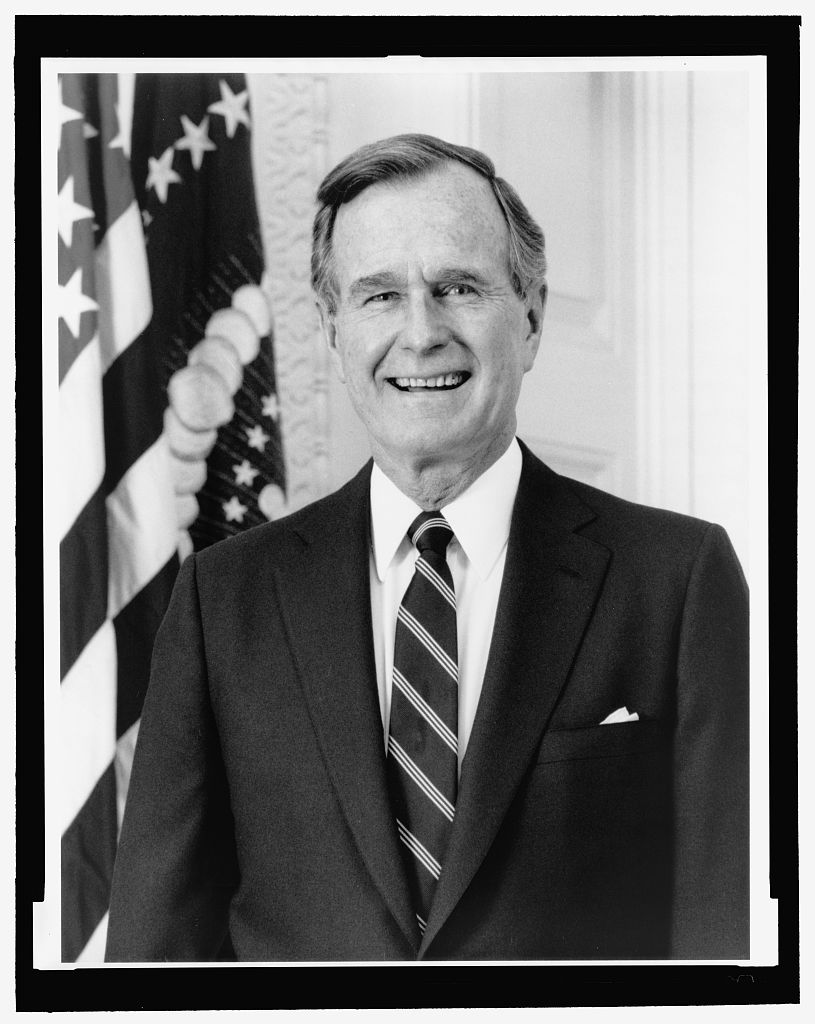
George H. W. Bush was the 41st president of the United States, serving from January 20, 1989, to January 20, 1993. A Republican and former vice president under Ronald Reagan, he led U.S. foreign policy through the end of the Cold War and the Gulf War.
Bush’s presidency is remembered chiefly for its foreign policy: he guided U.S. diplomacy during the collapse of the Soviet bloc, helped manage German reunification, and assembled an international coalition that liberated Kuwait in the 1990–91 Gulf War.
On the domestic front he signed major laws including the Americans with Disabilities Act and the 1990 Clean Air Act amendments, but his acceptance of a 1990 budget deal that raised taxes despite a campaign pledge hurt his political standing and contributed to his 1992 reelection defeat.
Led international coalition in the 1990–91 Gulf War to liberate Kuwait; Guided U.S. diplomacy during the end of the Cold War and German reunification; Signed the Americans with Disabilities Act into law (1990); Signed the Clean Air Act Amendments (1990); Agreed to a 1990 budget deal that included tax increases despite a campaign pledge
Key highlights and dated events associated with this presidency.
Showing 12 of 136 entries.
In a 5–4 decision the U.S. Supreme Court held that burning the American flag in protest is symbolic speech protected by the First Amendment.
The U.S. Senate voted to reject President Bush’s nomination of former Senator John Tower to be Secretary of Defense after hearings raised concerns about his personal conduct and ties to defense contractors.
Following the June 4 massacre in Beijing’s Tiananmen Square, President George H. W. Bush publicly condemned the violence and announced a suspension of high‑level contacts and military exchanges with China while Washington reviewed bilateral cooperation.
A powder charge explosion in a main-gun turret on the battleship USS Iowa during a gunnery exercise off Puerto Rico killed 47 crew members.
The U.S. Senate voted to reject President Bush's nomination of John Tower to be Secretary of Defense.
The oil tanker Exxon Valdez ran aground on Bligh Reef, spilling millions of gallons of crude oil into Prince William Sound and creating a major environmental disaster.
Richard B. "Dick" Cheney was confirmed by the U.S. Senate and sworn in as Secretary of Defense for the George H. W. Bush administration.
The U.S. Senate voted to reject President George H. W. Bush's nominee John Tower for Secretary of Defense after hearings that raised concerns about his personal conduct and business ties.
On 1989-02-15 the Soviet Union completed the withdrawal of its last troops from Afghanistan, ending a decade-long military intervention.
Bush nominated former Senator John Tower to be Secretary of Defense.
President George H. W. Bush nominated James A. Baker III to serve as Secretary of State.
Dan Quayle was sworn in as Vice President of the United States during the inauguration of George H. W. Bush.