Signs Executive Order 9835 Establishing the Federal Employee Loyalty Program
Truman signed Executive Order 9835 on March 21, 1947, creating a program to investigate federal employees for loyalty and suspected communist affiliations.
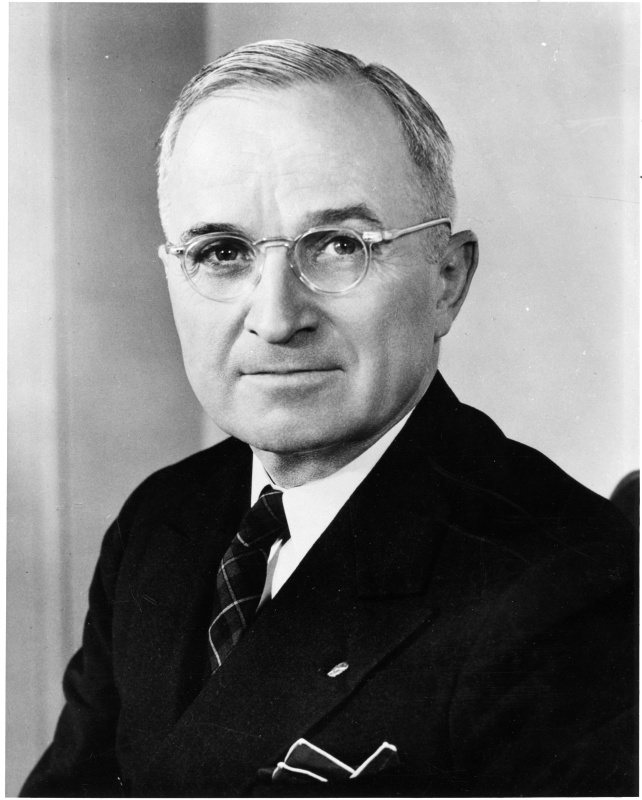
Harry S. Truman (1884–1972) was the 33rd President of the United States, serving from April 12, 1945 to January 20, 1953. A Democrat, he assumed the presidency after Franklin D. Roosevelt's death and guided the nation through the end of World War II and the early Cold War.
Truman reshaped America's postwar role, moving the nation from global war to Cold War leadership through the Marshall Plan, the Truman Doctrine, the Berlin Airlift, and the creation of NATO while confronting crises such as the Korean War.
On the domestic front he promoted the Fair Deal and took historic steps on civil rights, notably issuing Executive Order 9981 to desegregate the armed forces; his plainspoken leadership and decisive choices left a complex but enduring legacy that gained greater respect over time.
Assumed the presidency in 1945 and guided the transition from World War II to peacetime; Authorized use of atomic weapons against Japan (Hiroshima and Nagasaki); Articulated the Truman Doctrine and enacted the Marshall Plan to contain Soviet expansion; Supported the Berlin Airlift and helped establish NATO; Recognized the State of Israel in 1948; Issued Executive Order 9981 to desegregate the armed forces and led the U.S. during the Korean War (1950–1953)
Key highlights and dated events associated with this presidency.
Showing 12 of 276 entries.
Truman signed Executive Order 9835 on March 21, 1947, creating a program to investigate federal employees for loyalty and suspected communist affiliations.
Truman outlined a policy of supporting countries resisting authoritarian pressure, shaping early Cold War policy.
In a statement to Parliament, Ernest Bevin said Britain could no longer afford to provide economic and military assistance to Greece and Turkey.
On February 10, 1947, representatives of the United States and other Allied powers signed the Paris Peace Treaties with Italy, Romania, Hungary, Bulgaria, and Finland, formally concluding World War II hostilities with those nations.
George C. Marshall was sworn in as United States Secretary of State, succeeding James F. Byrnes.
President Truman delivered his annual message to a joint session of Congress outlining postwar domestic and foreign policy priorities and requesting legislative cooperation.
The newly elected 80th United States Congress convened on January 3, 1947, with Republicans assuming control of both the House and Senate and Joseph W. Martin Jr. chosen as Speaker of the House.
President Truman signed Executive Order 9808 establishing the President's Committee on Civil Rights to investigate the status of civil rights in the United States and recommend federal action.
Republican Richard M. Nixon defeated incumbent Democrat Jerry Voorhis in the congressional race for California's 12th District on Election Day.
Republican state senator Joseph R. McCarthy defeated incumbent Republican-turned-independent Robert M. La Follette Jr. in the U.S. Senate election in Wisconsin on Election Day.
In the midterm elections, Republican candidates captured majorities in both the House and the Senate, delivering a decisive defeat to Democrats nationwide.
On October 1, 1946 the International Military Tribunal at Nuremberg announced verdicts and sentences for major Nazi leaders accused of war crimes and crimes against humanity.