German decision announced to resume unrestricted submarine warfare
The German government announced it would resume unrestricted submarine warfare, authorizing U-boats to sink neutral and enemy shipping without warning beginning in February 1917.
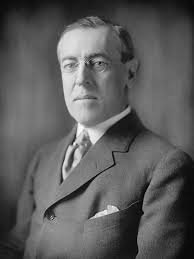
Woodrow Wilson was the 28th president of the United States, serving from March 4, 1913 to March 4, 1921. A Democrat and Progressive reformer, he led major domestic changes and guided the nation through World War I while advocating the League of Nations.
Wilson's presidency brought significant progressive reforms: he helped create the Federal Reserve System, strengthened antitrust enforcement, established the Federal Trade Commission, lowered tariffs and introduced a federal income tax. His administration also enacted labor protections and regulatory measures that reshaped the national economy.
Internationally, Wilson led the United States into World War I, articulated the Fourteen Points and pressed for a League of Nations to secure a new world order, but the Senate refused to ratify U.S. membership. His record is contested: he expanded federal authority and wartime censorship and instituted segregationist policies in the federal government, outcomes that have substantially affected historical assessments of his presidency.
Established the Federal Reserve System (1913) and modernized banking; Enacted antitrust and regulatory reforms including the Clayton Antitrust Act and Federal Trade Commission (1914); Lowered tariffs and introduced a federal income tax (Underwood Tariff, 1913); Led the U.S. through World War I and proposed the Fourteen Points; Championed the League of Nations but failed to secure Senate ratification; Implemented segregationist policies in federal offices and oversaw wartime suppression of dissent
Key highlights and dated events associated with this presidency.
Showing 12 of 252 entries.
The German government announced it would resume unrestricted submarine warfare, authorizing U-boats to sink neutral and enemy shipping without warning beginning in February 1917.
President Woodrow Wilson addressed a special session of the Senate arguing for a negotiated peace in World War I and warning against punitive victories by the belligerents.
German Foreign Secretary Arthur Zimmermann sent a secret diplomatic note proposing a German–Mexican military alliance against the United States if the U.S. entered the war.
Presidential electors met in the states on December 19, 1916, and cast their ballots for Woodrow Wilson and Thomas R. Marshall, producing the electoral majority for Wilson following the November election.
Woodrow Wilson delivered his annual message to Congress, outlining the need for continued defense preparedness, requesting military appropriations, and addressing U.S. neutrality amid the European war.
On November 7, 1916, Democratic incumbent Woodrow Wilson narrowly defeated Republican Charles Evans Hughes, securing a second term with 277 electoral votes to Hughes's 254.
President Woodrow Wilson signed the Keating–Owen Act, prohibiting the interstate shipment of goods produced by factories or mines employing children under specified ages.
President Woodrow Wilson signed the Adamson Act, requiring an eight-hour workday and time-and-a-half overtime pay for interstate railroad employees.
President Wilson signed the Naval Act of 1916, authorizing a major peacetime program of naval construction to expand the U.S. fleet.
On August 29, 1916 Congress created the Council of National Defense to coordinate industry, transportation, and labor for national security needs, with President Wilson to appoint its initial members.
Wilson signed the Jones Act (Philippine Autonomy Act), reorganizing the government of the Philippines and declaring U.S. policy toward eventual Philippine independence.
President Woodrow Wilson signed the National Park Service Organic Act, creating the National Park Service within the Department of the Interior.