
Poland re-establishes independence; Józef Piłsudski assumes authority in Warsaw
On November 11, 1918 Poland declared independence and Józef Piłsudski returned to Warsaw to assume political and military leadership of the newly reconstituted state.
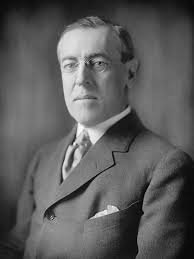
Woodrow Wilson was the 28th president of the United States, serving from March 4, 1913 to March 4, 1921. A Democrat and Progressive reformer, he led major domestic changes and guided the nation through World War I while advocating the League of Nations.
Wilson's presidency brought significant progressive reforms: he helped create the Federal Reserve System, strengthened antitrust enforcement, established the Federal Trade Commission, lowered tariffs and introduced a federal income tax. His administration also enacted labor protections and regulatory measures that reshaped the national economy.
Internationally, Wilson led the United States into World War I, articulated the Fourteen Points and pressed for a League of Nations to secure a new world order, but the Senate refused to ratify U.S. membership. His record is contested: he expanded federal authority and wartime censorship and instituted segregationist policies in the federal government, outcomes that have substantially affected historical assessments of his presidency.
Established the Federal Reserve System (1913) and modernized banking; Enacted antitrust and regulatory reforms including the Clayton Antitrust Act and Federal Trade Commission (1914); Lowered tariffs and introduced a federal income tax (Underwood Tariff, 1913); Led the U.S. through World War I and proposed the Fourteen Points; Championed the League of Nations but failed to secure Senate ratification; Implemented segregationist policies in federal offices and oversaw wartime suppression of dissent
Key highlights and dated events associated with this presidency.
Showing 12 of 252 entries.
On November 11, 1918 Poland declared independence and Józef Piłsudski returned to Warsaw to assume political and military leadership of the newly reconstituted state.
German and Allied representatives signed the Armistice of Compiègne on November 11, 1918, which went into effect at 11:00 a.m., ending large-scale hostilities on the Western Front.
On November 9, 1918 Kaiser Wilhelm II abdicated and revolutionary leaders proclaimed a German republic amid widespread unrest.
Congressional elections held November 5, 1918 resulted in Republican gains that gave the party control of both the House and the Senate.
On November 3, 1918 Austria-Hungary signed the Armistice of Villa Giusti with Italy and the Allies, ending hostilities on the Italian front.
On September 29, Allied forces—notably British, Australian, and American units—began a major assault across the St. Quentin Canal aimed at breaching the Hindenburg Line.
On September 29, Bulgaria signed an armistice at Salonica (Thessaloniki), ceasing military operations and effectively exiting World War I.
A massive Liberty Loan parade in Philadelphia on September 28 drew large crowds and immediately preceded a severe local surge in Spanish influenza cases and deaths.
On September 27, 1918 British and Canadian troops attacked across the Canal du Nord to breach the Hindenburg Line in a coordinated multi-day operation.
On September 26, 1918, the American Expeditionary Forces commenced the Meuse-Argonne Offensive, a major Allied attack aimed at breaking the German lines in northeastern France.
On September 19, 1918 General Edmund Allenby's forces began a major offensive in the Palestine theatre (the Battle of Megiddo), routing Ottoman forces across the Judean Hills and coastal plain.
On September 18, British Fourth Army launched an assault on German positions near Épehy on the Somme as part of the Allied Hundred Days Offensive.