Brendan Byrne re-elected governor of New Jersey
On November 8, 1977, incumbent Governor Brendan Byrne (Democrat) defeated Republican Raymond Bateman in New Jersey's gubernatorial election.

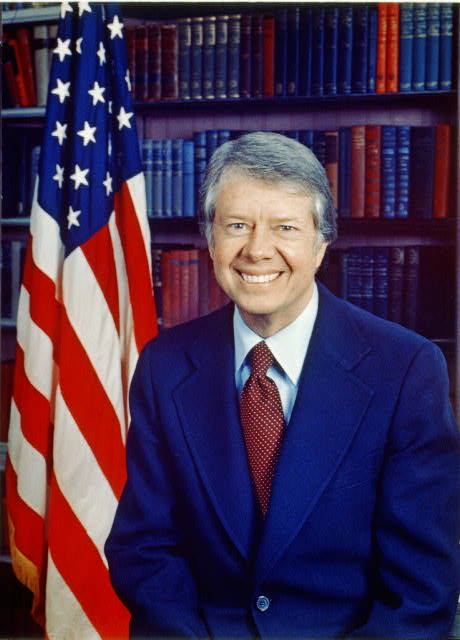
Jimmy Carter, a Democrat, served as the 39th President of the United States from January 20, 1977, to January 20, 1981. His administration emphasized human rights, energy policy, and negotiating peace in the Middle East.
Carter's presidency is remembered for diplomatic achievements such as brokering the 1978 Camp David Accords between Egypt and Israel and negotiating the 1977 Panama Canal Treaties, along with major domestic initiatives including the creation of the Departments of Energy and Education and passage of the National Energy Act.
His term was marred by economic difficulties—stagflation and an energy crisis—and by the 1979–1981 Iran hostage crisis, which eroded public confidence. After leaving office he became a prominent global humanitarian and human-rights advocate, founding the Carter Center and receiving the Nobel Peace Prize in 2002.
Brokered the 1978 Camp David Accords between Egypt and Israel; Signed the 1977 Panama Canal Treaties to transfer canal control; Established the Departments of Energy and Education and pushed the 1978 National Energy Act; Promoted a human-rights-centered foreign policy and negotiated SALT II; Faced the 1979–1981 Iran hostage crisis and led a failed rescue attempt; Advanced deregulation in transportation (airlines, trucking, rail)
Key highlights and dated events associated with this presidency.
Showing 12 of 87 entries.
On November 8, 1977, incumbent Governor Brendan Byrne (Democrat) defeated Republican Raymond Bateman in New Jersey's gubernatorial election.
President Jimmy Carter signed the Community Reinvestment Act (CRA) into law, directing federal regulators to assess banks’ records in meeting the credit needs of their entire communities, including low- and moderate-income neighborhoods.
James R. Schlesinger was sworn in as the inaugural Secretary of the newly formed Department of Energy as the agency began operations.
The newly created U.S. Department of Energy began operations on October 1, 1977, consolidating various federal energy programs into a single cabinet-level agency.
President Jimmy Carter and Panama's leader Omar Torrijos signed two treaties in Panama City transferring control of the Panama Canal to Panama and guaranteeing its neutrality.
NASA's unmanned probe Voyager 2 launched from Cape Canaveral on an Atlas-Centaur rocket, beginning its long-duration mission to the outer planets and beyond.
President Carter signed the Department of Energy Organization Act, creating the Department of Energy as a cabinet-level department.
President Jimmy Carter signed the Surface Mining Control and Reclamation Act (SMCRA) into law, establishing federal standards for coal mining operations and land reclamation.
A massive power outage struck New York City on the night of July 13–14, 1977, leaving millions without electricity and leading to extensive looting, arson, and civil disorder across the city.
The Senate confirmed civil-rights leader Andrew Young to serve as U.S. Ambassador to the United Nations.
The Senate confirmed Admiral Stansfield Turner to serve as Director of Central Intelligence, and he took charge of the CIA.
On February 28, 1977, President Jimmy Carter transmitted his first federal budget to Congress for fiscal year 1978, outlining spending priorities that emphasized energy and human resources while proposing restraint in defense spending.