Martin Luther King Jr. delivers 'Beyond Vietnam' speech at Riverside Church
MLK delivered his controversial 'Beyond Vietnam: A Time to Break Silence' address in New York, publicly denouncing the Vietnam War and criticizing U.S. policy.
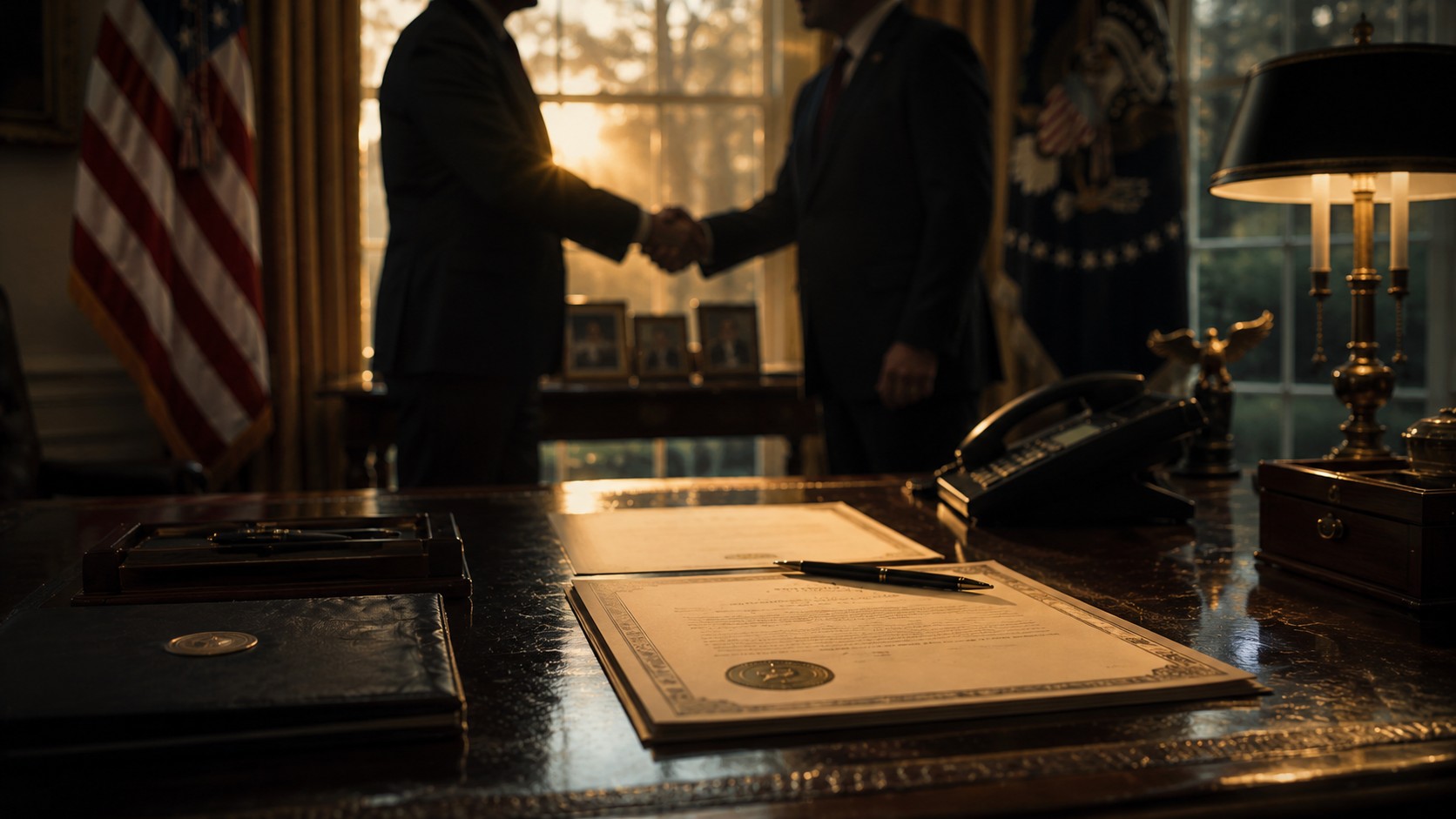
Lyndon B. Johnson, a Democrat from Texas, became president after John F. Kennedy's assassination in 1963 and served until 1969. He pursued an ambitious domestic agenda while presiding over a major escalation of the Vietnam War.
Johnson’s domestic agenda, known as the Great Society, expanded civil rights, health care, education, and anti-poverty programs, producing landmark laws such as the Civil Rights Act, the Voting Rights Act, Medicare, and Medicaid.
His decision to escalate U.S. military involvement in Vietnam eroded public support and overshadowed many of his achievements, leaving a complex legacy that reshaped civil rights, social policy, and debates over U.S. foreign intervention.
Signed the Civil Rights Act (1964) and Voting Rights Act (1965); Created Medicare and Medicaid (1965); Launched the Great Society and War on Poverty initiatives; Escalated U.S. military involvement in the Vietnam War; Enacted the Immigration and Nationality Act (1965)
Key highlights and dated events associated with this presidency.
Showing 12 of 216 entries.
MLK delivered his controversial 'Beyond Vietnam: A Time to Break Silence' address in New York, publicly denouncing the Vietnam War and criticizing U.S. policy.
On March 10, 1967, Ramsey Clark was sworn in as United States Attorney General, taking leadership of the Justice Department under President Johnson.
President Lyndon B. Johnson signed the Wholesome Meat Act, amending the Federal Meat Inspection Act to require state meat inspection programs to be 'at least equal to' federal standards.
On February 22, 1967 U.S. and Army of the Republic of Vietnam forces launched Operation Junction City, a major offensive in Tay Ninh Province aimed at destroying the Viet Cong Central Office for South Vietnam.
On January 27, 1967 the Treaty on Principles Governing the Activities of States in the Exploration and Use of Outer Space (the Outer Space Treaty) was opened for signature in Washington, London, and Moscow and the United States signed the treaty under the Johnson administration.
A flash fire during a pre-launch test of Apollo 1 at Cape Kennedy killed astronauts Virgil 'Gus' Grissom, Edward H. White II, and Roger B. Chaffee.
President Johnson's appointee Alan S. Boyd was sworn in as the inaugural Secretary of the newly created Department of Transportation.
President Lyndon B. Johnson delivered the 1967 State of the Union to a joint session of Congress, reviewing Great Society initiatives and addressing the ongoing U.S. involvement in Vietnam.
U.S. and Army of the Republic of Vietnam forces launched Operation Cedar Falls on January 8, 1967, a major offensive aimed at clearing Viet Cong bases in the Iron Triangle north of Saigon.
In the November 8, 1966 midterm elections Republicans picked up a number of seats in both the House and the Senate, but Democrats retained majorities in both chambers.
President Johnson signed the Demonstration Cities and Metropolitan Development Act of 1966, creating the Model Cities Program to coordinate federal aid for urban renewal and anti-poverty efforts.
President Lyndon B. Johnson signed the Department of Transportation Act, establishing the U.S. Department of Transportation as a federal Cabinet-level agency.