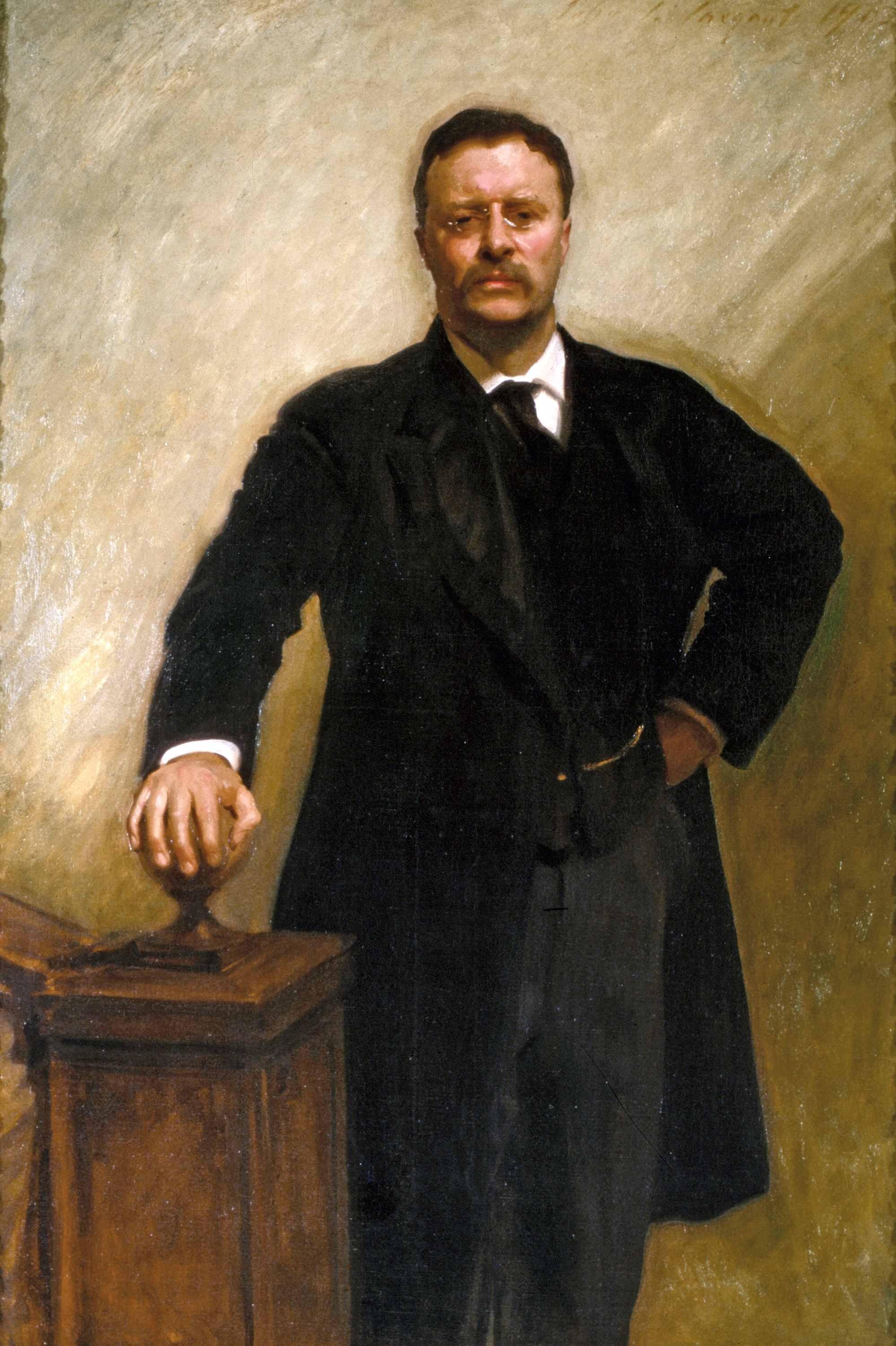
Awarded the 1906 Nobel Peace Prize
The Nobel Committee awarded President Theodore Roosevelt the 1906 Nobel Peace Prize for his mediation in ending the Russo-Japanese War and the resulting Treaty of Portsmouth.
Theodore Roosevelt was the 26th president of the United States, serving from 1901 to 1909 after succeeding William McKinley. A Republican reformer and conservationist, he expanded federal regulation, trust-busting, and American influence abroad.
Roosevelt broadened the role of the federal government in regulating business and protecting consumers. His "Square Deal" policies included antitrust actions, the Pure Food and Drug Act, and major conservation initiatives that created national parks, forests, and monuments.
He transformed the presidency into a more active office and pursued an assertive foreign policy summarized by "speak softly and carry a big stick." He mediated the end of the Russo-Japanese War, advanced construction of the Panama Canal, and left a lasting impact on American institutions and global presence.
Assumed the presidency after William McKinley’s assassination (1901); Launched the "Square Deal" with trust-busting and regulatory reforms; Enacted the Pure Food and Drug Act and Meat Inspection Act (1906); Established national parks, forests, and monuments through expanded conservation policy; Brokered peace in the Russo-Japanese War, receiving the 1906 Nobel Peace Prize; Supported Panama Canal construction and demonstrated U.S. naval power (Great White Fleet).
Key highlights and dated events associated with this presidency.
Showing 12 of 136 entries.
The Nobel Committee awarded President Theodore Roosevelt the 1906 Nobel Peace Prize for his mediation in ending the Russo-Japanese War and the resulting Treaty of Portsmouth.

President Theodore Roosevelt used the Antiquities Act to designate the Petrified Forest in northeastern Arizona as a National Monument.
President Theodore Roosevelt used his authority under the Antiquities Act to designate Montezuma Castle in Arizona as a national monument.
President Theodore Roosevelt delivered his 1906 annual message to Congress outlining his priorities for conservation, trust regulation, and continued federal regulatory reforms.
In the midterm elections on November 6, 1906, Republicans kept control of both the House and the Senate, though they ceded some seats to Democrats.
President Theodore Roosevelt ordered the dishonorable discharge of 167 African American soldiers of the 25th Infantry following the Brownsville incident in Texas.
President Theodore Roosevelt used the Antiquities Act to proclaim Devils Tower in northeastern Wyoming a United States National Monument.
On the night of August 13, 1906, gunfire in Brownsville, Texas led local residents to accuse Black soldiers of the 25th Infantry of involvement, touching off the Brownsville Affair.
On August 13, 1906, shots were fired in Brownsville, Texas, resulting in a local death and immediate accusations against Black soldiers of the 25th Infantry stationed nearby.
On the night of August 13, 1906, shots were fired in Brownsville, Texas, leaving a local resident dead and others wounded, and local citizens immediately blamed soldiers of the African American 25th Infantry stationed nearby.
On the night of August 13, 1906, gunfire in Brownsville, Texas left a town resident dead and local authorities accused Black soldiers from the nearby 25th Infantry post of involvement.
On the night of August 13, 1906, shots were fired in Brownsville, Texas, leaving one man dead and another wounded; local residents and officials accused Black soldiers of the 25th Infantry stationed nearby.