Outbreak of the Philippine–American War (engagements near Manila)
On February 4, 1899, armed clashes between U.S. Army forces and Filipino troops near Manila erupted into open hostilities, marking the start of the Philippine–American War.
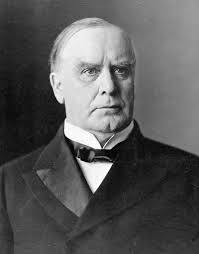
William McKinley (1843–1901) was the 25th President of the United States, serving from 1897 until his assassination in 1901. A Republican, he led the nation through the Spanish-American War and pursued pro-business economic policies including protective tariffs and the gold standard.
McKinley’s presidency marked the United States’ emergence as an international power after victory in the Spanish-American War and the acquisition of overseas territories such as Puerto Rico, Guam, the Philippines, and the annexation of Hawaii. Domestically, he promoted economic stability through the Dingley Tariff and the Gold Standard Act, aligning the federal government with business and industrial interests.
His administration accelerated American overseas expansion, a legacy that generated lasting debate over imperialism and national identity. McKinley’s assassination in 1901 brought Theodore Roosevelt to the presidency and helped usher in a more activist, progressive phase of American governance.
Led the U.S. in the Spanish-American War (1898) and negotiated the Treaty of Paris;Annexed Hawaii and oversaw acquisition of Puerto Rico, Guam and the Philippines;Enacted the Dingley Tariff to raise protective tariffs (1897);Signed the Gold Standard Act (1900) to stabilize currency;Articulated the Open Door Policy promoting equal trade access in China;Assassinated in 1901, succeeded by Theodore Roosevelt
Key highlights and dated events associated with this presidency.
Showing 12 of 99 entries.
On February 4, 1899, armed clashes between U.S. Army forces and Filipino troops near Manila erupted into open hostilities, marking the start of the Philippine–American War.
President McKinley appointed a three-member 'First Philippine Commission' under Jacob G. Schurman to investigate conditions in the Philippines and advise the administration on governance of the islands.
President McKinley issued a proclamation declaring U.S. intention to 'benevolently assimilate' the Philippine Islands and directing U.S. military authorities to take possession following Spain's cession.
The United States and Spain signed the Treaty of Paris, in which Spain ceded Puerto Rico, Guam, and the Philippines to the United States and relinquished sovereignty over Cuba.
On November 8, 1898, midterm elections produced gains for the Republican Party in the U.S. House and made modest advances in Senate and gubernatorial contests.
A detachment of U.S. Army troops engaged members of the Pillager Band of Ojibwe at Sugar Point, Minnesota, suffering several casualties and withdrawing after the engagement.
President McKinley dispatched U.S. peace commissioners, led by William R. Day, to Paris to open formal negotiations with Spain over terms to end the Spanish–American War.
Following the capture of Manila on August 13, U.S. Army forces under General Wesley Merritt proclaimed a U.S. military government in the city on August 14, 1898.
U.S. forces took Manila from Spanish control after a planned assault on August 13, 1898, resulting in the surrender of Spanish troops in the city.
U.S. and Spanish representatives signed an armistice (the Protocol of Peace) on August 12, 1898, agreeing to cease hostilities while peace terms were to be negotiated.
Following the July 25 landing at Guánica, American troops entered and took control of the city of Ponce after Spanish authorities evacuated and the town surrendered on July 28, 1898.
U.S. troops under Major General Nelson A. Miles landed at Guánica, Puerto Rico on July 25, 1898, beginning the Puerto Rico Campaign.