NASA announces selection of the Mercury Seven astronauts
NASA publicly named the first seven American astronauts—Scott Carpenter, Gordon Cooper, John Glenn, Gus Grissom, Wally Schirra, Alan Shepard, and Deke Slayton—on April 9, 1959.

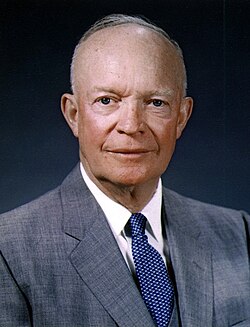
Dwight D. Eisenhower (1890-1969) was a five-star general in World War II and served as the 34th President of the United States from 1953-1961. A Republican, he presided over postwar prosperity, built the Interstate Highway System, and shaped early Cold War policy.
Eisenhower's presidency stabilized the United States during a period of economic growth and Cold War tension. He prioritized infrastructure and scientific investment, signing the Federal-Aid Highway Act and creating NASA while pursuing containment and cautious diplomacy.
He advanced civil rights enforcement in limited but consequential ways—sending federal troops to enforce desegregation at Little Rock and signing the Civil Rights Act of 1957—and appointed Chief Justice Earl Warren, influencing landmark Supreme Court rulings. His farewell warning about the "military-industrial complex" and the use of covert actions during the Cold War have left a complex and lasting legacy.
Supreme Allied Commander in World War II; Negotiated a Korean War armistice, ending large-scale combat; Created the Interstate Highway System (Federal-Aid Highway Act of 1956); Established NASA (1958) and strengthened the U.S. space program; Enforced school desegregation at Little Rock and signed the Civil Rights Act of 1957; Warned of the "military-industrial complex" in his 1961 farewell address
Key highlights and dated events associated with this presidency.
Showing 12 of 271 entries.
NASA publicly named the first seven American astronauts—Scott Carpenter, Gordon Cooper, John Glenn, Gus Grissom, Wally Schirra, Alan Shepard, and Deke Slayton—on April 9, 1959.
On March 31, 1959, the 14th Dalai Lama reached Indian territory after escaping Lhasa amid the March uprising against Chinese rule.
President Dwight D. Eisenhower signed the Hawaii Admission Act (Public Law 86-3), formally approving the bill that would enable Hawaii to become a U.S. state.
On March 17 the 14th Dalai Lama secretly left the Potala Palace and fled Lhasa toward India as Chinese suppression of the uprising intensified.
Mass protests and armed clashes erupted in Lhasa on March 10 as Tibetans rose against Chinese rule, marking the start of the 1959 Tibetan uprising.
The United States launched Pioneer 4 from Cape Canaveral on March 3, 1959; the probe passed within the Moon's vicinity on March 4 and entered heliocentric orbit, becoming the first American spacecraft to escape Earth orbit.
In the days after Fulgencio Batista's flight, the Eisenhower administration and the U.S. diplomatic mission in Havana extended de facto recognition to the provisional government that had replaced Batista.
President Dwight D. Eisenhower delivered his annual State of the Union message to a joint session of Congress, presenting an overview of the administration's policies and national priorities for 1959.
After Alaska's admission as the 49th state, its elected U.S. senators Ernest Gruening and Bob Bartlett and Representative Ralph J. Rivers were sworn into Congress on January 3, 1959.
On January 3, 1959, Alaska was formally admitted to the Union as the 49th state, with President Dwight D. Eisenhower signing the proclamation of admission.
On January 1, 1959, Fidel Castro's rebel column entered Havana as Fulgencio Batista fled, effectively toppling the Batista government in Cuba.
Soviet Premier Nikita Khrushchev delivered an ultimatum demanding that the United States, Britain, and France withdraw their military forces from West Berlin within six months and turn the city over to East German control.